IEEE Transactions on Visualization and Computer Graphics · 2025
2DGH: 2D Gaussian-Hermite Splatting for
High-quality Rendering and Better Geometry Features
1Department of Physics, Tsinghua University
2School of Software & BNRist, Tsinghua University
*Equal contribution · †Corresponding author
Abstract
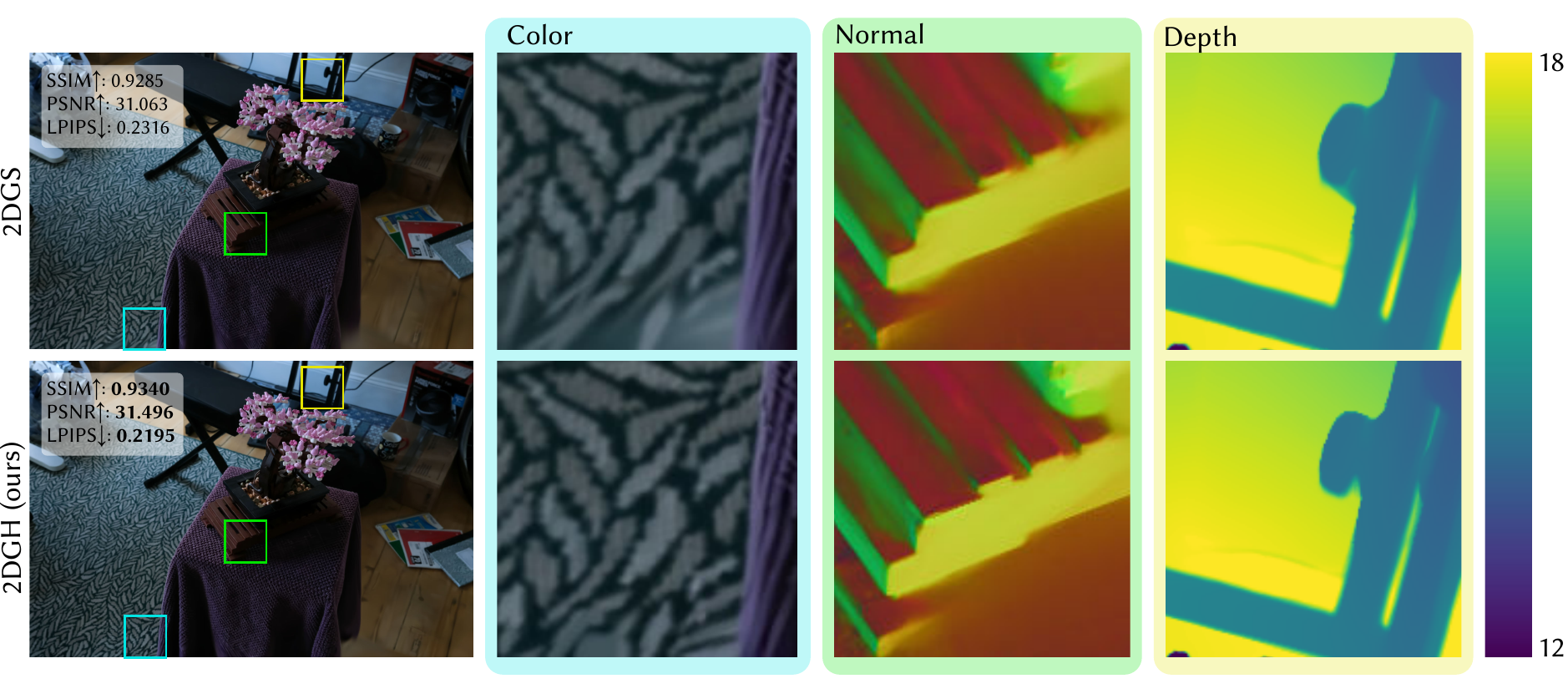
2D Gaussian Splatting has recently emerged as a significant method in 3D reconstruction, enabling novel view synthesis and geometry reconstruction simultaneously. While the well-known Gaussian kernel is broadly used, its lack of anisotropy and deformation ability leads to dim and vague edges at object silhouettes, limiting the reconstruction quality of current Gaussian splatting methods.
To enhance the representation power, we draw inspiration from quantum physics and propose to use the Gaussian-Hermite kernel as the new primitive in Gaussian splatting. The new kernel takes a unified mathematical form and extends the Gaussian function, which serves as the zero-rank special case in the updated general formulation.
Our experiments demonstrate that the proposed Gaussian-Hermite kernel achieves improved performance over traditional Gaussian Splatting kernels on both geometry reconstruction and novel-view synthesis. On the DTU dataset, our method yields more accurate geometry reconstruction; on MipNeRF360 and our customized Detail dataset, it achieves better novel-view synthesis — highlighting the potential of the Gaussian-Hermite kernel for high-quality 3D reconstruction and rendering.
Triangle Fitting Toy
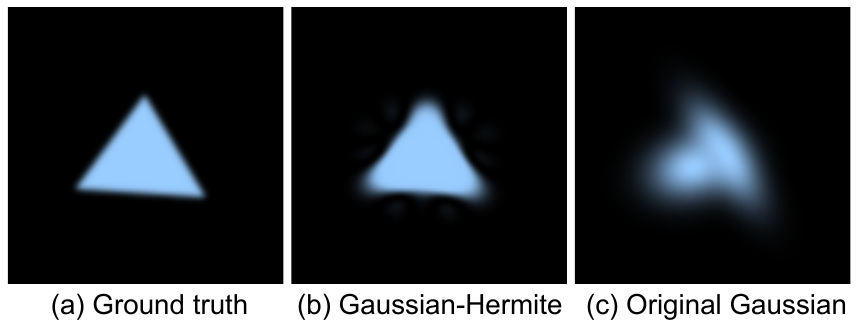
A simple sanity check: fit a triangle with two primitives. Two rank-5 Gaussian-Hermites recover the sharp edges; two original Gaussians can only suggest the rough silhouette. This is the failure mode that motivates the new primitive on real scenes.
Where does that extra representational power come from? The Gaussian-Hermite primitive is the Gaussian multiplied by a 2D Hermite polynomial of rank (m, n). Slide m and n below to watch the basis pattern unfold — new lobes appear along each axis, alternating in sign.
Values are normalised per pattern so the colour scale always spans −1 … +1. Rank (0, 0) recovers the plain Gaussian; higher rank adds oscillating lobes that let the primitive carve sharper, more anisotropic shapes.
Results
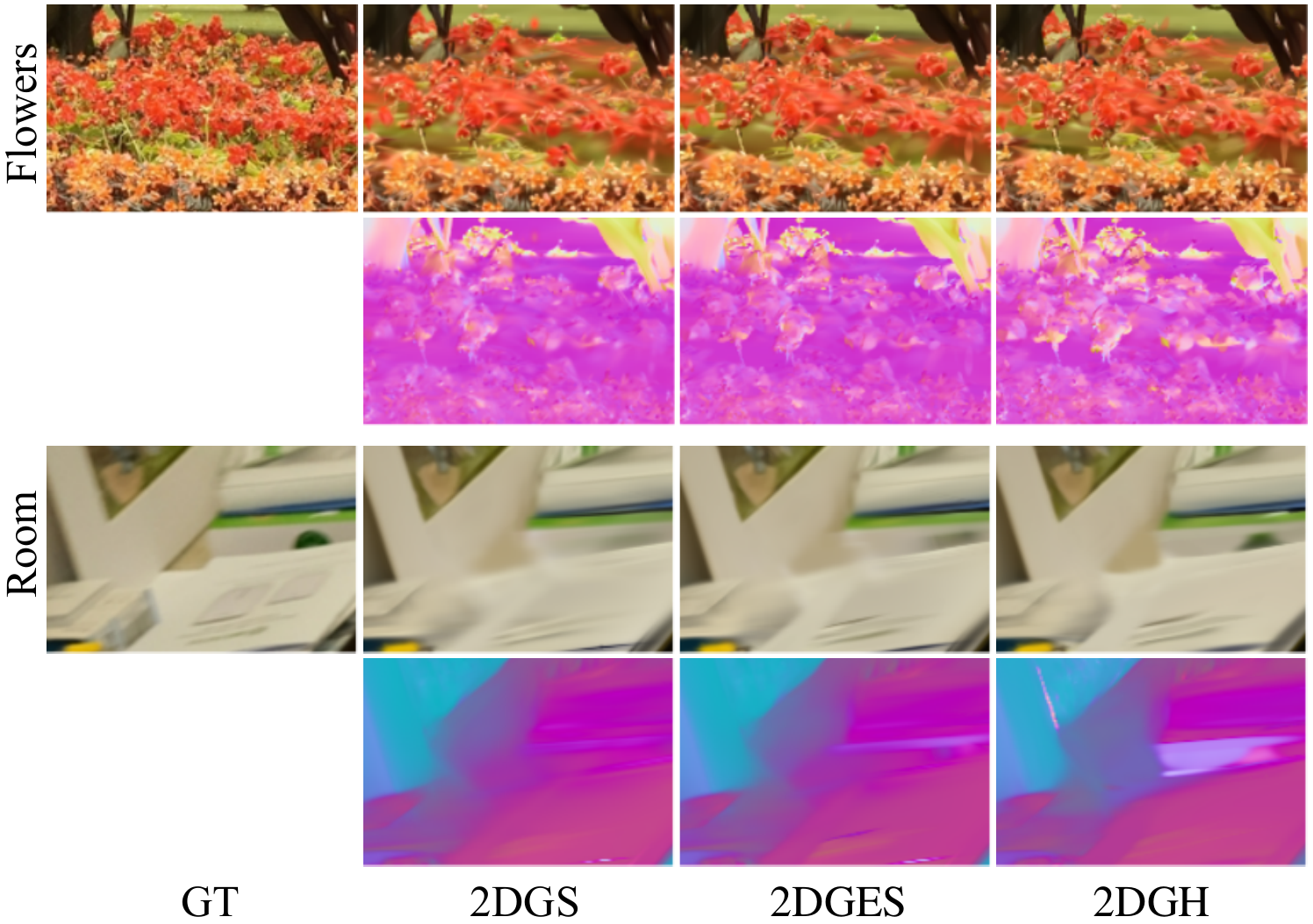
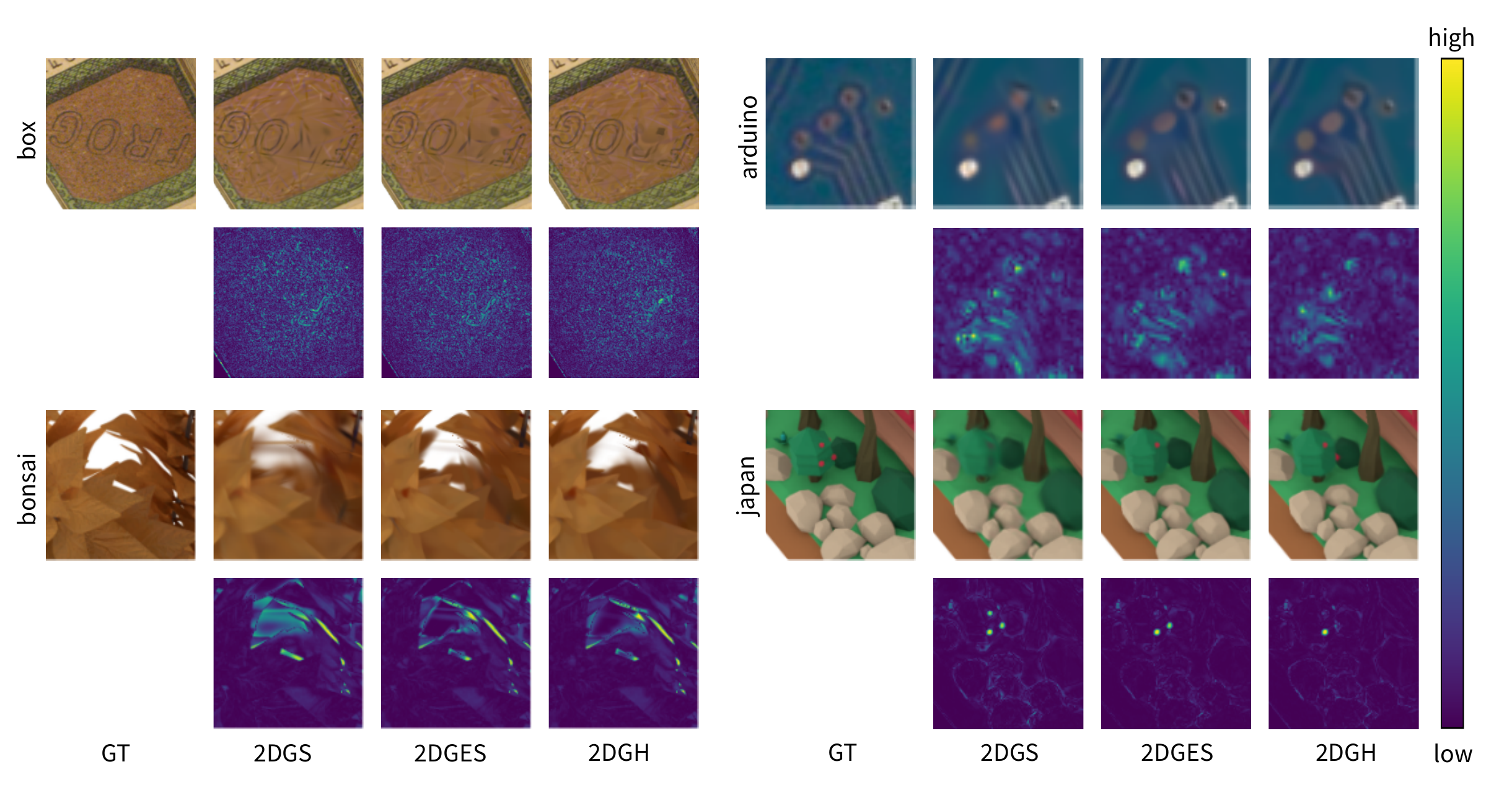
Across MipNeRF360, our Detail dataset, and DTU, the Gaussian-Hermite primitive consistently sharpens silhouettes and high-frequency texture while keeping the splatting pipeline unchanged. Below are qualitative comparisons against 2DGS and 2DGES; full quantitative tables are in the paper.
BibTeX
@article{yu2025gaussianhermite,
  title   = {2DGH: 2D Gaussian-Hermite Splatting for High-quality Rendering
             and Better Geometry Features},
  author  = {Yu, Ruihan and Huang, Tianyu and Ling, Jingwang and Xu, Feng},
  journal = {IEEE Transactions on Visualization and Computer Graphics},
  year    = {2025}
}